
Boating
Wake boats and your lake: what the research says and what associations can do
Last reviewed: October 30, 2026. Laws, ordinances and research change; check the linked pages before your board acts.
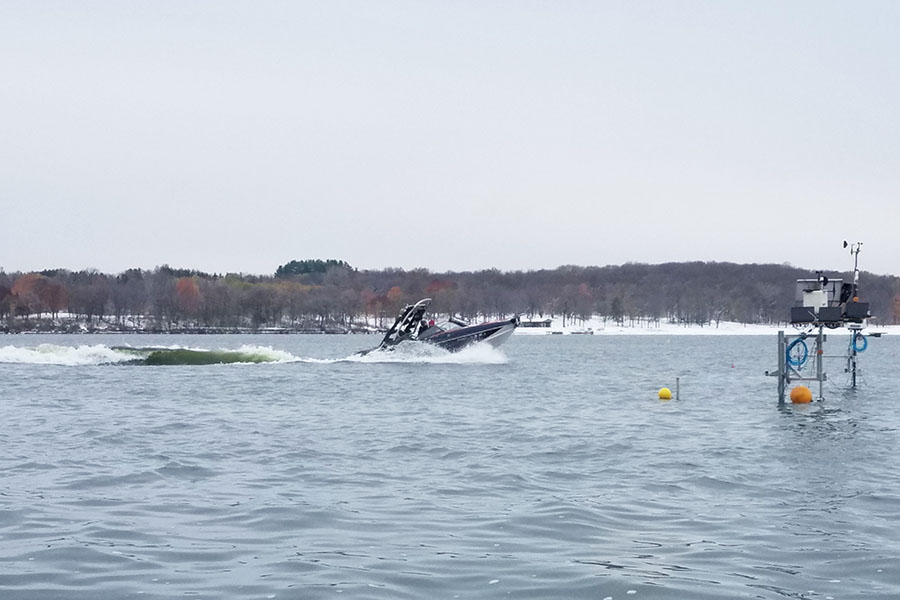
Wakes are one of the most divisive topics on Minnesota lakes, and Brainerd-area associations hear about them every summer. The president of the Minnesota Coalition of Lake Associations has said the three complaints his group hears most are personal safety, shoreline erosion and lakebed disruption.
Minnesota still has no statewide wake-surfing rule. But the research is much clearer than it was two years ago, more boaters now need a state permit, and a few counties have started acting lake by lake. Here is where things stand going into 2027, with sources, so your board can talk about wakes with facts instead of anecdotes.
What Minnesota law says today
There is no state law setting a minimum distance or depth for wake surfing. What exists is a mix of guidance, general boating law and a new permit requirement:
- The 200-foot guideline is a recommendation, not a rule. The DNR recommends that all boaters stay at least 200 feet from shore and other boats, and that anyone making a wake avoid repeated passes through the same area.
- Wake damage is already the operator's problem. State law generally prohibits boating that harasses others or damages property, though lake advocates note it is hard to enforce.
- Towing and surfing rules apply. Under the 2026 Minnesota Boating Guide, a boat making a wake for a surfer needs a wide rear-view mirror or a second person watching, and wake surfing is not allowed from a half hour after sunset until sunrise.
- More boaters now need a permit. Minnesota's watercraft operator permit is phasing in by birth date: born after June 30, 2004 (since July 1, 2025); after June 30, 2000 (since July 1, 2026); after June 30, 1996 (from July 1, 2027); and after June 30, 1987 (from July 1, 2028). Motors of 25 hp or less are exempt, and the course is meant to cover wake and propeller impacts on shorelines and lake bottoms, according to MN COLA.
- Local rules are possible, but they start locally. Speed, wake and other surface-use restrictions come from the town, city or county, need a public hearing, and must be approved by the DNR before they take effect.
Statewide setback bills have been introduced since 2020 (HF 3770), and a 2025 bill targeted one stretch of the Mississippi River (SF 95). As of this writing, Minnesota has not enacted a statewide wake-surfing setback.
What the University of Minnesota research found
Two studies from the University of Minnesota's St. Anthony Falls Laboratory (SAFL) now anchor most of the conversation. They measure different things, so it helps to keep them apart.
2022: how far the waves travel. Researchers measured waves from four boats on Lake Independence, two built for wake surfing and two typical recreational boats. In surf mode, the wakesurf boats made waves roughly two to three times higher, reaching about 20 inches at 100 feet, according to Twin Cities Business. To shrink their waves to the level of a typical boat at 200 feet, the wakesurf boats needed more than 500 feet in normal surfing operation, or more than 425 feet when both boat types were run for their biggest waves.
2025: what happens below the surface. The second study used seven boats over two field seasons on Lake Minnetonka. It found that propeller wash and boat waves can stir up lakebed sediment, and that the water stays disturbed for minutes after a boat passes. After a wakeboat pass in surf mode, sediment took about 8 minutes to settle at 14 feet of depth and more than 15 minutes at 9 feet, as Eos reported. The study's recommendation: wakeboats in surf mode should operate in at least 20 feet of water.
What the research doesn't settle. The boating industry, including the National Marine Manufacturers Association, supports a 200-foot setback and argues the 2022 study shouldn't justify 500 feet or more, because it measured waves rather than actual shoreline damage at 200 feet. A third phase of SAFL research, funded by the state's Environment and Natural Resources Trust Fund, is comparing boat waves with wind-driven waves over three years, according to the Phase 2 report.
In short, many lake groups now treat 500 feet from shore and 20 feet of depth as the science-based best practice for surf mode. It is guidance, not law.
What other lakes and states have done
Only one Minnesota lake has a DNR-approved wake-surfing ordinance so far, and one county board is weighing a second. Neighboring states have gone further.
| Where | Status | Distance | Depth | Other terms |
|---|---|---|---|---|
| Caribou Lake, Cook County, MN | DNR-approved local ordinance (2024) | 500 ft from shore or another boat | 20 ft | Bans wake enhancement by ballast, hydrofoils or transition speed |
| Pickerel Lake, Becker County, MN | Proposed; county board declined a ban in Aug 2026 | Board open to 300 ft | — | Association asked to submit a revised proposal |
| Vermont | State rule (2024) | 500 ft | 20 ft | Wake zone must cover 50+ acres; "home lake" rule unless decontaminated |
| Maine | State law (2024) | 300 ft | 15 ft | Civil fines; boater education outreach |
Caribou is a useful example of how a lake gets there. The property owners' association petition was signed by owners of 71% of the lake's private shoreline. Their argument was about the lake itself: at 721 acres with a 12-foot average depth, almost none of Caribou is both 500 feet from shore and 20 feet deep.
Pickerel shows the other side. Residents described safety incidents and erosion, but a Becker County commissioner had earlier warned that lake-by-lake rules put an enforcement load on the sheriff, and the board did not adopt the ban as written.
What your association can do this winter
Winter is the right time to work on this: the boats are off the water and tempers have cooled. A few practical steps:
- Look at your lake's map first. Pull your lake's depth map from DNR LakeFinder and mark where the water is at least 20 feet deep and 500 feet from shore. On a big lake there may be plenty of room; on a smaller one there may be almost none. That turns "whether" into "where," which is an easier conversation.
- Educate before you regulate. A calm newsletter piece in spring can share the DNR's 200-foot guideline, the 500-foot and 20-foot best practice from the research, and the permit phase-in. Ask resorts, rental outfits and marinas on your lake to pass it along.
- Hear from all your members. Wake boaters pay dues too. A short member survey tells your board where people actually stand before anyone proposes a rule.
- Keep a factual record. Dated photos of shoreline damage, notes on close calls, and reports to the county sheriff's water patrol carry more weight than general complaints if your lake ever asks for an ordinance.
- Know the ordinance path. It starts with your town, city or county, requires a public hearing and needs DNR approval. Caribou's broad shoreline-owner support helped; Pickerel shows that county boards also weigh enforcement.
- Don't forget invasive species. Wakeboat ballast systems may not drain completely, which some lake groups flag as an invasive species risk and which Vermont's home-lake rule was designed to address. Remind members to drain all water before leaving any lake.
The goal for most associations isn't to ban a sport. It's to make sure everyone on the lake, from paddlers to surfers, can share it safely.
How Lake Association Office can help
If your board wants to take this up over the winter, we can draft a balanced newsletter article on wakes from your board's notes, so members get the facts in plain language. Large Office also includes one member survey a year, a simple way to learn where your members stand before anyone proposes a rule. Your board approves everything before it goes out.
We don't draft ordinances or give legal advice; your county, the DNR and your own attorney are the right sources for that.
Not sure where your lake stands? A Free Lake Snapshot is a one-page summary of public state data on your lake, with no commitment.
Sources
- Minnesota DNR, news release on sharing waterways and the 200-foot recommendation (June 25, 2026)
- Minnesota DNR, 2026 Minnesota Boating Guide
- Minnesota DNR, Initiating local surface use zoning
- Echo Press, New law requires boating permits in Minnesota
- MN COLA, Wake boats posts and permit details and Enhanced wakes lumber across the US (May 26, 2024)
- Minnesota Legislature, HF 3770 (2020) and SF 95 (2025)
- University of Minnesota College of Science and Engineering, UMN researchers study waves created by recreational boats (Feb. 2022)
- Twin Cities Business, U of M researchers probe impacts of wakesurfing
- St. Anthony Falls Laboratory, Phase 2 report: A Field Study of Recreational Powerboat Hydrodynamics and their Impacts on the Water Column and Lakebed (July 2025), and summary
- Eos, A debate over wakes in the land of 10,000 lakes (Aug. 29, 2025)
- Caribou Lake Property Owners' Association, petition letter to Cook County (Sept. 9, 2022)
- Detroit Lakes Tribune, Becker County opts not to ban wake surfing on Pickerel Lake (Aug. 2026)
- InForum, Becker County lake associations interested in regulating wake boats
- Green Lake Association, Wake boats
- Minnesota DNR, LakeFinder